
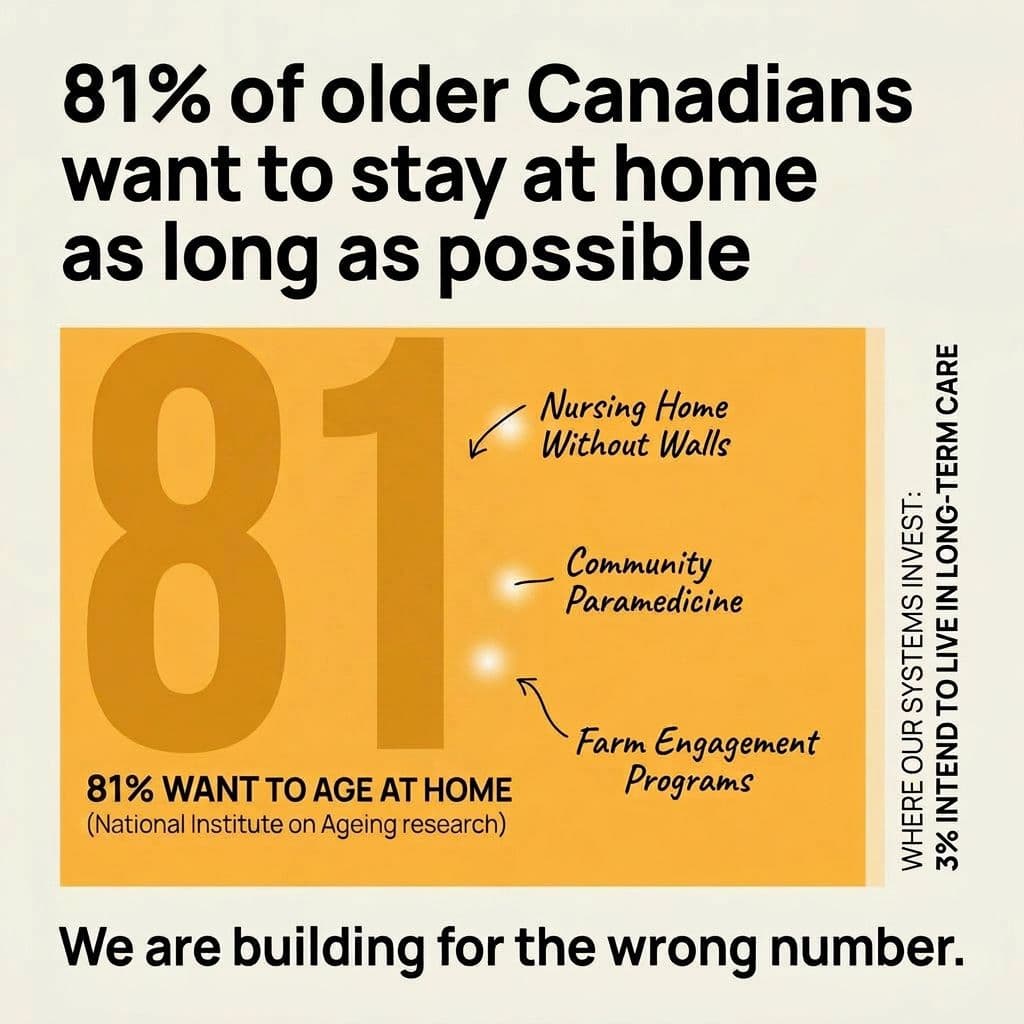
81% of older Canadians want to stay in their homes for as long as possible.
Only 3% plan to move into long-term care.
This data, from the National Institute on Ageing, exposes a fundamental misalignment in how we’ve designed our care systems.
We are still building for the 3%.
Not the 81%.
The System Is Backwards
For decades, elder care in Canada has been structured around institutions. Long-term care homes, retirement residences, and hospital systems dominate the landscape. They are necessary, but they were never meant to be the default.
And yet, that’s what they’ve become.
When the vast majority of people want to age at home, but the system funnels them toward facilities, something is clearly broken.
The issue isn’t a lack of demand. It’s a lack of imagination and scale.
The Models That Are Getting It Right
At the National Caregiver Day Symposium, I saw real, working examples of what the future could look like. Not theories. Not pilot ideas. Actual programs delivering results.
1. Nursing Home Without Walls (New Brunswick)
This model flips the traditional system on its head.
Instead of moving seniors into nursing homes, it brings nursing home-level services directly to them. Individuals receive the care they need, when they need it, while continuing to live at home.
It’s flexible. It’s efficient. And it acknowledges something simple but often ignored: home is not just a place, it’s a foundation for dignity.
This kind of model allows people to move fluidly between structured care and independent living, depending on their needs. It also opens the door for long-term care homes to extend their reach beyond their physical walls.
2. Community Paramedicine (Nova Scotia, PEI)
Another powerful example is community paramedicine.
Here, paramedics are no longer just emergency responders. They are care providers delivering services like palliative care directly in the home.
The results are hard to ignore:
- 53% of cases diverted away from emergency departments
- $2.4 million in return on investment
More importantly, people receive care in the place they feel most comfortable, without unnecessary hospital visits.
This is what system efficiency actually looks like.
3. Farm-Based Engagement Programs (Japan, Netherlands)
Not all care is clinical.
In countries like Japan and the Netherlands, older adults participate in community farming programs. They contribute. They stay active. They remain socially connected.
This isn’t just about reducing isolation. It’s about preserving identity and purpose.
Because care without purpose is incomplete.
A Clear Pattern Emerges
Across all of these models, the same principle shows up again and again:
Bring care to people. Don’t bring people to care.
This is the shift we need.
- Keep people in their communities
- Keep them socially connected
- Keep them in environments that feel familiar and safe
And most importantly, align our systems with what people actually want.
The Opportunity in Front of Us
Canada does not need to reinvent the wheel.
The models exist.
The data supports them.
The demand is overwhelming.
What’s missing is scale.
There is a massive opportunity to expand these approaches across provinces, integrate them into existing infrastructure, and rethink how care is delivered at a systems level.
For organizations, startups, and policymakers, this is not just a moral imperative. It’s a strategic one.
Where GALA Fits In
At GALA, this is exactly the problem we’re building toward.
If the future of care is decentralized, personalized, and home-based, then the infrastructure to support that future needs to exist.
- Matching individuals with the best options of care providers
- Coordinating services seamlessly.
- Making care accessible without forcing institutional transitions.
This is how we start building for the 81%.
The Bottom Line
We already know where people want to age.
We already have models that prove it can work.
The question is no longer if we should change the system.
It’s whether we’re willing to build something that actually reflects reality.
What systems or innovations have you seen that are helping people age at home?
Email us at info@galacares.com, we would love to hear from you.